Solar does Fusion's job, today
In the first half of this decade, global solar capacity has tripled, and in some markets, the wholesale price of electricity dropped into the negatives during peak production hours.
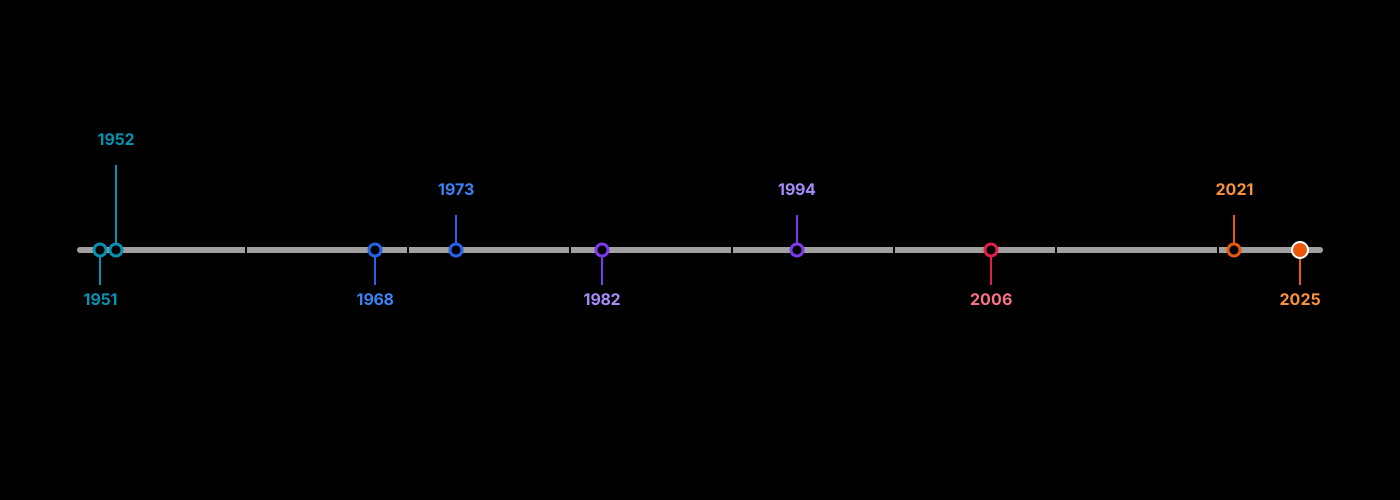
Meanwhile, the promise of highly abundant, cheap, and clean energy delivered by nuclear fusion has sat just outside of reach, reaching its seventh decade of development.
Today, proponents of fusion like Sam Altman point to it as an engine for economic prosperity, and a means for green energy production to catch up with escalating demands for power. While proponents push a nuclear future as the solution for tomorrow’s demand, much of today’s escalating demand is being fulfilled by fossil fuels (see xAi’s natural gas turbines) 4.
The scale of fusion research has ebbed and flowed since the prospect was imagined in the 1940s,1 with great attention during the 1970s during a period of uncertainty around fossil fuels.2 Fusion energy has been pictured as a path towards a nuclear paradise, or as the key to energy independence. Though public funding has waned, governments and private firms alike have powered forward, with near-free energy as the prize. Firms such as Helion energy, TAE technologies, and ZAP energy have collectively raised billions to research fusion energy.3
What if this promise of abundant, cheap energy could be fulfilled without banking on technological breakthroughs?
Solar: Cheap & Plentiful, Already
There is no practically reachable limit to the amount of solar we can collect on earth, and collecting this solar is near-free once panels are installed. The rate at which we are installing these panels is causing huge changes to energy markets today.
In Australia, power regulators are considering providing electricity at zero cost during peak production hours.12 In the European Union, sunny days have led to negative wholesale electricity prices.1314 In South Africa, long-standing struggles with grid outages are being alleviated affordably with cheap solar panels.15 Not only is solar already meeting demand that would've been met with fossil fuels, it is doing so affordably at a wide scale.
Solar production is increasing around the world, rapidly: worldwide capacity doubled from 1TW to 2TW between 2022 and 2024.16 Energy usage has been a hot-button topic in the United States in 2025, and notably in this same year, 61% of new demand was matched by solar expansion.17
Hard-line proponents of fusion might argue that solar does not satisfy the needs that fusion would, since it inherently is seasonal and a given solar installation can not generate power around the clock. This ignores complementary renewables, and massive strides made in grid storage. However, even while discounting the growing ability of grid storage, today’s renewables can already accomplish fusion’s job.
Industrial & Scaling Demand
To an economy, sufficient affordable energy is vital to industry. With the correct equipment, electricity can be “exported” in the form of physical or digital goods. By scaling demand according to energy scarcity, a grid can flatten the demand profile for energy, similarly to how one might with grid storage.
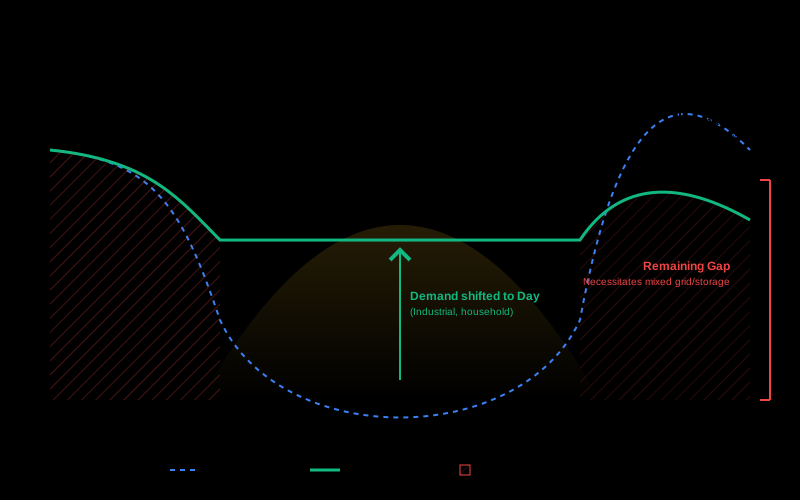
Datacenters are notoriously power hungry, consuming grid or on-site electricity to produce digital goods remotely for global consumers. Electricity is the major marginal cost component for this, and one can frame selling compute time as exporting electricity. The chips and climate control equipment in the datacenter is the processing machinery that converts this local electricity into exported server time or tokens.
AI workloads are a good opportunity for solar to fulfill fusion promises, considering demand is highly distributable, and with peak usage following the sun. AI inference demand could certainly be fulfilled largely locally, with nighttime usage being routed further away. For a large amount of AI inference use cases, in particular those not relying on ultra-low-latency, an additional latency of eg. 120ms should not meaningfully affect user experience.19 Inference demand is expected to far exceed training demand into the future.20
In fact, cloud providers such as Google are already investing in the required infrastructure and systems to shift data center load to follow cheap and clean energy around the planet.29 Considering electricity availability rather than hardware availability is expected to be the limiting factor for hyperscale AI clusters,21 it is likely this strategy of following the sun (and other cheap renewables, such as wind) will not only be good financial sense, but practically necessary to meet demand.
"our way of exporting electricity, if you will, is through aluminum"
— Halla Hrund Logadóttir
Iceland and Quebec both practice the process of embodying the value of electricity in physical, shippable goods, taking advantage of abundant (though non-solar) energy to smelt aluminum and export the refined product. When the daytime marginal cost of electricity is near-zero, it is highly attractive to scale aluminum production up during the day and down during the evening. For this reason, there has been a great deal of research put into how aluminum plants could be designed to scale energy demand with supply. A German plant has accomplished ± 25% energy modulation, while staying online.23 Even this heavy-duty process can be adjusted to fit better into the solar production curve, allowing us to treat the aluminum plant as effectively a battery in itself, sinking or shedding capacity depending on supply.
Another promise of fusion-driven abundance includes desalination, assuaging water scarcity in arid and drying regions. Conveniently, many areas with demand for desalination are sunny. In Saudi Arabia, the Al Khafji seawater reverse-osmosis plant uses a 20MW solar array to desalinate fresh water for thousands.22 Although some water is needed 24h a day, storing desalinated water is comparatively cheap and simple compared to storing electricity. This makes it feasible to scale production with electricity availability and demand. Massive-scale storage of water is a low-tech, already solved problem. Although there may be efficiency gains to be made by running desalination plants around the clock, free electricity is enough to make it worth scaling the desalination process in accordance with energy prices.
Scaling Household Demand
The imagined benefit of fusion to the typical consumer is more likely to focus around energy bills rather than economic prosperity. Beyond empowering industry, cheap electricity alleviates costs for households. Several utility companies offer demand based pricing, allowing consumers to choose times when energy is cheap and abundant to run power-hungry appliances. In the UK, this was found to be effective at flattening the demand curve, with Octopus Energy observing a 28% shift in consumption.24 Some utilities have even offered incentives to allow home thermostats to be coordinated with grid availability - when air conditioning is a major cost component, cooling the air in an insulated house is similar to charging a battery to soak up cheap energy. A cold house will stay cold as energy prices rise in the evening (and might stay cool all night with minimal extra energy usage).
Solar is unlikely to deliver 0-margin cheap power throughout the night without mass energy storage, but as demonstrated, 24/7 cheap energy is not a requirement for a household to decrease its energy bill.
Grid Storage & Mixed Grid
The common critique of solar, that it needs batteries or a mixed grid to match characteristics for today’s grid, is true. However, a 100-percent-solar grid is not a goal we need to or should strive for: our capacity to install grid storage and build other renewable power sources is massive and increasing. In California, during some periods, batteries have been the primary energy supply 18. Grid storage has increasing adoption every year, all the while becoming cheaper to install. Other infrastructure like wind or grid-conditioning installations are likewise being built alongside solar. This allows us to rapidly close the gap between a demand-shifted solar grid and a grid with classical baseload.
Amortization Problem:
With regards to aluminum smelters and other capital and electric intensive industries, it is highly desirable to run workloads around the clock. Since an aluminum smelter is quite capital-intensive, a smelter may still desire to pay the premium for expensive, overnight electricity, so as to “pay off” the machinery twice as fast. To satisfy the demands of these plants, a mixed grid or grid storage will be necessary to some degree. Additionally, the 25% modulation achieved in Germany may be near the limits of current processes. Aluminum plants will likely continue to operate where non-solar renewable energy is plentiful (Iceland, Quebec, with geothermal and hydro respectively).
In the case of AI, accelerator chips are also a large capital expenditure. Even with this in mind, electricity is still a major bottleneck for datacenters - on one datacenter campus in California, 96 Megawatts of datacenter capacity sits idle, waiting for grid capacity.25 AI workloads may shift into high-solar hours not because the operational expenses would otherwise exceed the capital expenses, but out of basic necessity. The cost of sitting idle during evening hours is trumped by the cost of never being connected to the grid.
Intermittency Problem
Of course, even if we vastly overbuild solar capacity, it is not a safe bet to assume there will be sunny weather across an entire continent every day. This can be mitigated somewhat by a grid operator being able to transfer energy between regions (with some efficiency losses over great distances, especially without specialized transmission equipment, like HVDC lines used in Quebec).26 Another attractive defense mechanism is to rely on a variety of renewable energy sources. Wind turbines pair exceptionally well with solar, in that they can be very quick and cheap to build, have extremely low ongoing costs, and would likely be spinning even when the sun is down, obscured by clouds, or less plentiful during the winter.
Inertia Problem:
Turbine-based energy (which future-tech fusion may use) has an additional benefit of providing stability to the grid. The physical inertia of spinning turbines ensures the grid operates at the desirable frequency, even when load on the grid varies. Solar panels lack this ability.
To resolve this, one option is to rely on installations like flywheels or synchronous condensers, which serve as stand-ins for spinning turbines to condition voltage & frequency of the grid.27 Other technologies, like grid-forming inverters, can also help condition the grid without relying primarily on spinning masses.28
Like with the other caveats, another solution is to acknowledge our “solar paradise” will include a variety of generation sources, such as wind turbines, geothermal, and hydroelectricity, depending on region. Although "solar paradise" is a punchy name to contrast against a "fusion paradise", this grid will certainly be made up of complementary renewables & some grid storage. Note
The Paradise
Let's examine how different the “fusion paradise” looks to a “solar paradise”.
In a fusion paradise, energy is green, abundant, and can be supplied with a rather small footprint. To enable megawatts of capacity, a large capital expense must be expended to build the device, and 24hr baseload will be unlocked.
This is rather straightforward, however this simplicity may stem from the technology remaining unproven. We have not yet revealed the complexities that come with a fusion grid.
Contrasting to a solar paradise, energy is likewise green and abundant, though supplied with a comparatively larger footprint. Still, in comparison to other leading land uses, the footprint is rather small. We trade a few reactors dotted around a country for swaths of deserts and roofs painted with solar. The major comparative advantage of solar is that capex can be as small or large as we need - it is very cheap to add kilowatts of capacity, and the price scales well when we add megawatts. This scaling remains attractive even when accounting for the grid storage or mixed generation required in a renewable grid.
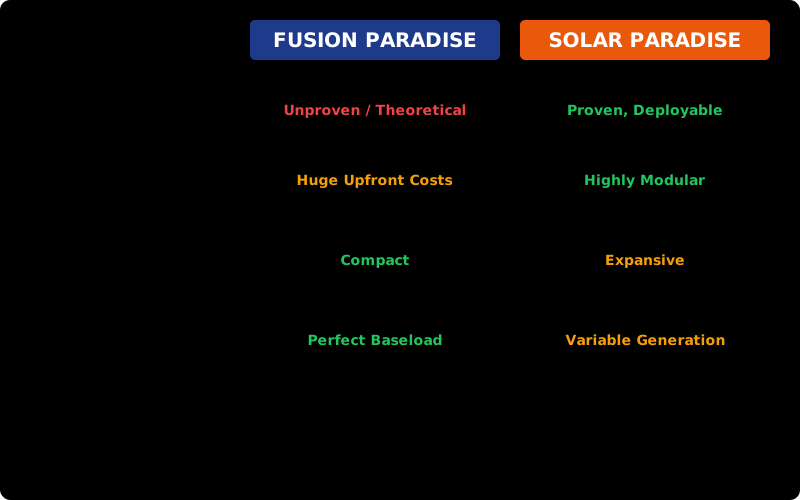
Neither option stands out as perfect, but as of 2026 one option seems rather more proven & possible with today's technology. We do not yet know the realities of a fusion grid, and likely will not have the data to reason about it for some years - years where the planet will continue to gain demand for power, and years where we must meet this demand.
Fast deployment, modularity, and flexible capital expenditure make deploying solar highly attractive to the market at large, and makes it a very low-barrier way for nations to improve their grid’s energy sovereignty and carbon intensity. Barring a monumental push from bad actors, market forces will be enough to bring us close to the “solar paradise” before fusion gets a chance to take off.
Links
- I have not discussed the role of non-renewable green energy sources, i.e. fission. Do not take this to mean that solar is incompatible with a fission plant, which *would* provide much-needed baseload capacity. In fact, there is very little wrong with a fission plant, other than the fact that they are vastly expensive to build and scale in comparison to solar. ↩
- https://worldwide.espacenet.com/patent/search/family/001730355/publication/GB817681A?q=pn%3DGB817681 ↩
- https://www.iter.org/node/20687/10th-anniversary-end-operations-tftr-tokamak ↩
- https://www.helionenergy.com/articles/announcing-500-million-fundraise/ ↩
- https://oilprice.com/Energy/Energy-General/Elon-Musks-xAI-Data-Center-Sparks-Environmental-Legal-Battle.html ↩
- https://www.sherwoodtheory.org/history.php ↩
- https://www.tandfonline.com/doi/full/10.1080/15361055.2025.2503035 ↩
- https://www.ipp.mpg.de/4239000/50_years_en.pdf ↩
- https://web.ornl.gov/info/news/pulse/no380/feature.shtml ↩
- https://www.pppl.gov/tokamak-fusion-test-reactor ↩
- https://www.iter.org/about/history ↩
- https://tae.com/trump-media-and-technology-group-to-merge-with-tae-technologies/ ↩
- https://www.abc.net.au/news/2025-11-03/energy-retailers-offer-free-power-three-hours-dmo/105965472 ↩
- https://carboncredits.com/europes-power-paradox-why-electricity-prices-went-below-zero-in-2025/ ↩
- https://www.energyglobal.com/special-reports/30122025/negative-electricity-prices-blessing-or-curse/ ↩
- https://mybroadband.co.za/news/energy/610916-south-africans-with-rooftop-solar-power-outgunning-eskom.html ↩
- https://happyeconews.com/global-solar-capacity-hits-2-tw/ ↩
- https://ember-energy.org/latest-updates/solar-met-61-of-us-electricity-demand-growth-in-2025/ ↩
- https://www.ess-news.com/2025/05/28/californian-batteries-set-new-output-record/ ↩
- https://www.nngroup.com/articles/response-times-3-important-limits/ ↩
- https://www.mckinsey.com/industries/technology-media-and-telecommunications/our-insights/the-next-big-shifts-in-ai-workloads-and-hyperscaler-strategies ↩
- https://www.hanwhadatacenters.com/blog/top-energy-companies-for-ai-data-centers-2025-power-guide/ ↩
- https://www.typsa.com/en/supervision-de-la-planta-desaladora-de-al-khafji/ ↩
- https://enpot.cn/assets/technical-resources/Depree-TMS2016-The-Virtual-Battery.pdf ↩
- https://www.smsenergy.com/insights/smart-time-of-use-tariff-shows-significant-impact-on-energy-consumption-behaviour/ ↩
- https://www.tomshardware.com/tech-industry/data-centers-in-nvidias-hometown-sit-idle-as-grid-struggles-to-keep-up ↩
- https://www.hydroquebec.com/learning/transport/grandes-distances.html ↩
- https://www.entsoe.eu/technopedia/techsheets/synchronous-condenser/ ↩
- https://www.energy-storage.news/akaysha-energy-switches-on-410mwh-grid-forming-bess-in-australia-five-months-ahead-of-schedule/ ↩
- https://blog.google/innovation-and-ai/infrastructure-and-cloud/global-network/data-centers-work-harder-sun-shines-wind-blows/ ↩
- https://ember-energy.org/latest-updates/global-solar-installations-surge-64-in-first-half-of-2025/ ↩